Introduction
What is agntcms
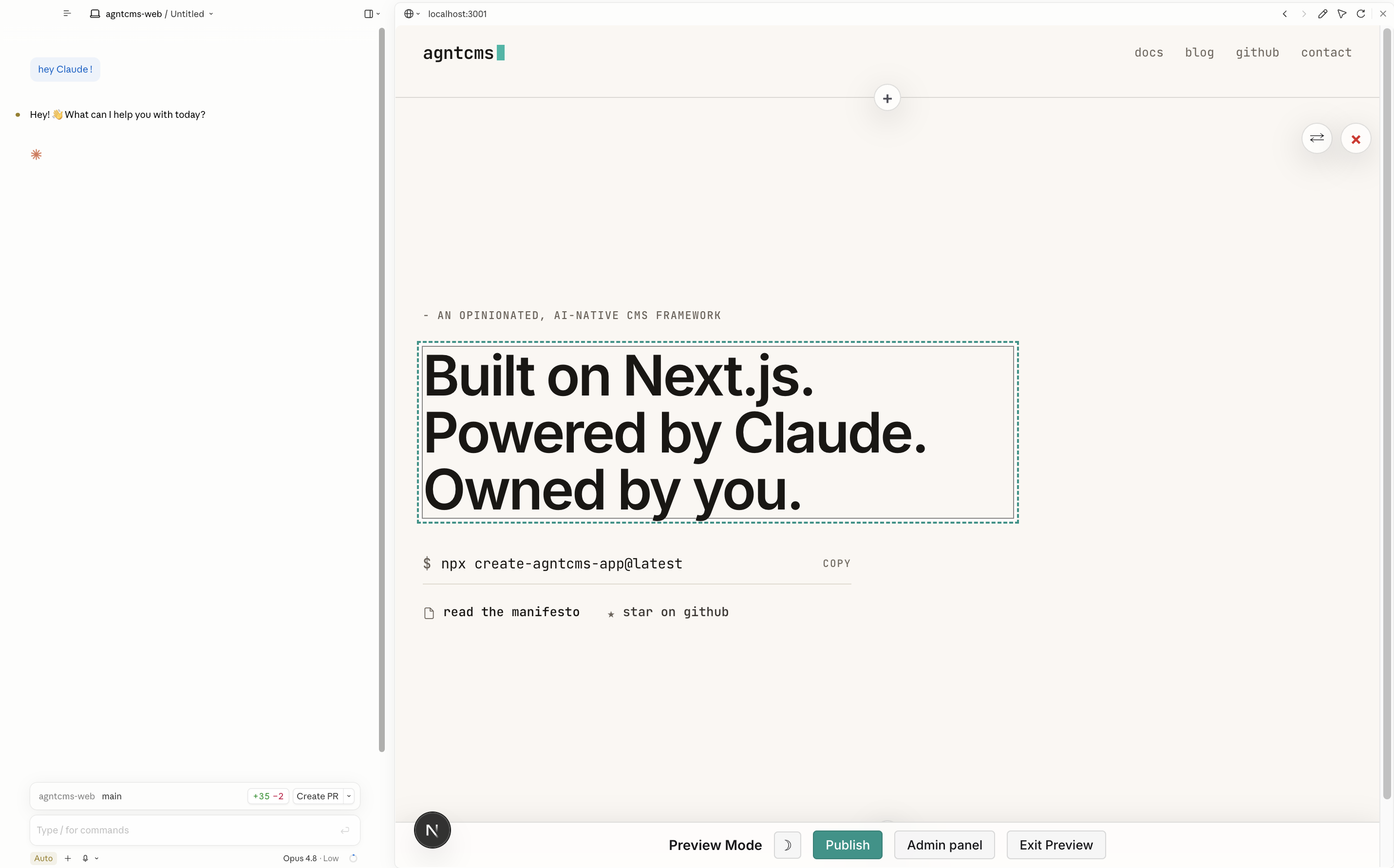
agntcms is a Next.js framework for content sites where the AI agent is the primary way you edit, not a dashboard. Inside is a full headless CMS with drafts, version history, asset management, an inline-edit UI, and section replace. But instead of clicking through forms, you describe what you want in plain language and the agent makes it happen.
The core idea#
The agent that does the editing is Claude Code Desktop, and it works through skills. Each skill is one CMS operation, like create a page, edit a field, publish a draft, or roll back. When you describe a task, Claude picks the right skill, the skill calls the framework, and the preview refreshes. You never touch a query language or a form schema.
That is the whole inversion. Traditional headless CMS keeps everything content sites need and bolts an agent on as one more client. agntcms keeps that same capability but puts the agent at the centre and the human plugs in through it. Skills first, files second.
What you get out of the box#
A working Next.js + headless-CMS template. Standard Next.js App Router.
pnpm create agntcms-app and you have a running demo in two minutes — see Install and Explore the demo.Drafts and version history. Every edit lands in
content/drafts/<slug>.json first. Publishing moves it to content/pages/<slug>.json and writes a timestamped snapshot to content/history/<slug>/. Rollback is one skill call. Drafts are committed to git too — switching machines or handing the project off does not lose work.Asset management. Images and files live under
public/assets/<sha256>.<ext>. Filenames are content hashes, so identical uploads deduplicate automatically and cache invalidation is free. The image picker stores { filename, alt } on the page JSON; the framework wires the rest.Inline-edit UI. Run the dev server, click the preview-mode toggle in the corner, and every editable text and image gains a hover outline. Click to edit in place — markdown source on one side, preview on the other for text; an upload picker for images. For bigger jobs (rewrite tone, restructure a section), drop back into Claude Code.
Section replace. Each section has a swap action that hands the slot to a different section type and fills in sensible defaults from the new schema. The dedicated framework endpoint owns the move so the page JSON stays valid throughout.
22 Claude Code skills (
@agntcms/skills). One skill per operation — create page, edit page, edit a single text field, replace a section, publish a draft, roll back, rename a slug, scaffold a new section type, migrate from a Claude Design bundle. The agent picks the skill from the task; you do not memorise names. Full list in Skills.A frozen production build. All the admin, all the inline-edit UI, the channel between agent and UI — all stripped from the production build via
.dev.ts route suffixes. What ships to visitors is a plain, fast Next.js app with no AI runtime dependency.Why should I care#
Every major headless CMS now ships "AI" — but the agent is a third-party client calling an API designed for a human editor. Schemas, queries, permissions, editorial workflow — all of it predates the agent. agntcms inverts the architecture. The agent is the primary actor in the system; the human plugs in through it, not around it. Skills are first-class API; the inline-edit UI is the secondary surface for clicks, not the primary one for intent.
The economics follow. MIT-licensed, self-hosted, no per-seat pricing. No 48-content-type ceiling, no locale paywall, no $40K/year for 50 editors, no Enterprise call to unlock a fourth language. Deployed as a normal Next.js app on Vercel — headless-grade capability at the cost of the runtime you were already paying for.
Bring your own agent. The skills are the same primitives your existing LLM pipelines call — scheduled content refreshes, brief-driven page generation, programmatic localization, SEO sweeps. The CMS and your content ops automation are the same surface, not two systems stitched together through webhooks and a vendor SDK.
This is for the 90% of content sites — marketing pages, landing pages, corporate resources, content portals — that have been overpaying for an omnichannel architecture they never used. Not for 50-person editorial teams with five-tier approval flows; that case stays with traditional headless.
Stack#
Three pieces, all required, none configurable.
- Next.js (15+). Your site is a normal Next.js App Router project. Deploy anywhere Next.js runs.
@agntcms/nextand@agntcms/skills. The runtime — domain model, storage adapters, React components, HTTP handlers — and the agent's skills, synced into.claude/skills/. Both ship in lockstep; update them together.- Claude Code Desktop. The primary editing surface, the place you type tasks, the host of the embedded preview pane. Without it, the framework is just Next.js — no agent, no skills, no AI-native flow.
That is a deliberate choice: the stack is not configurable so the agent can sit deeper than any plugin could. Other LLMs and tools are not supported in v0.5.
Where to go next#
- Just starting? Install → Explore the demo → Setup personalised project. Two minutes to a running demo, an hour to your own on-brand site.
- Already have a project, want to edit it? Editing — getting started.
- Want the model first? Concepts and Architecture.
- Curious what the agent can do? Skills — 22 of them, grouped by purpose.