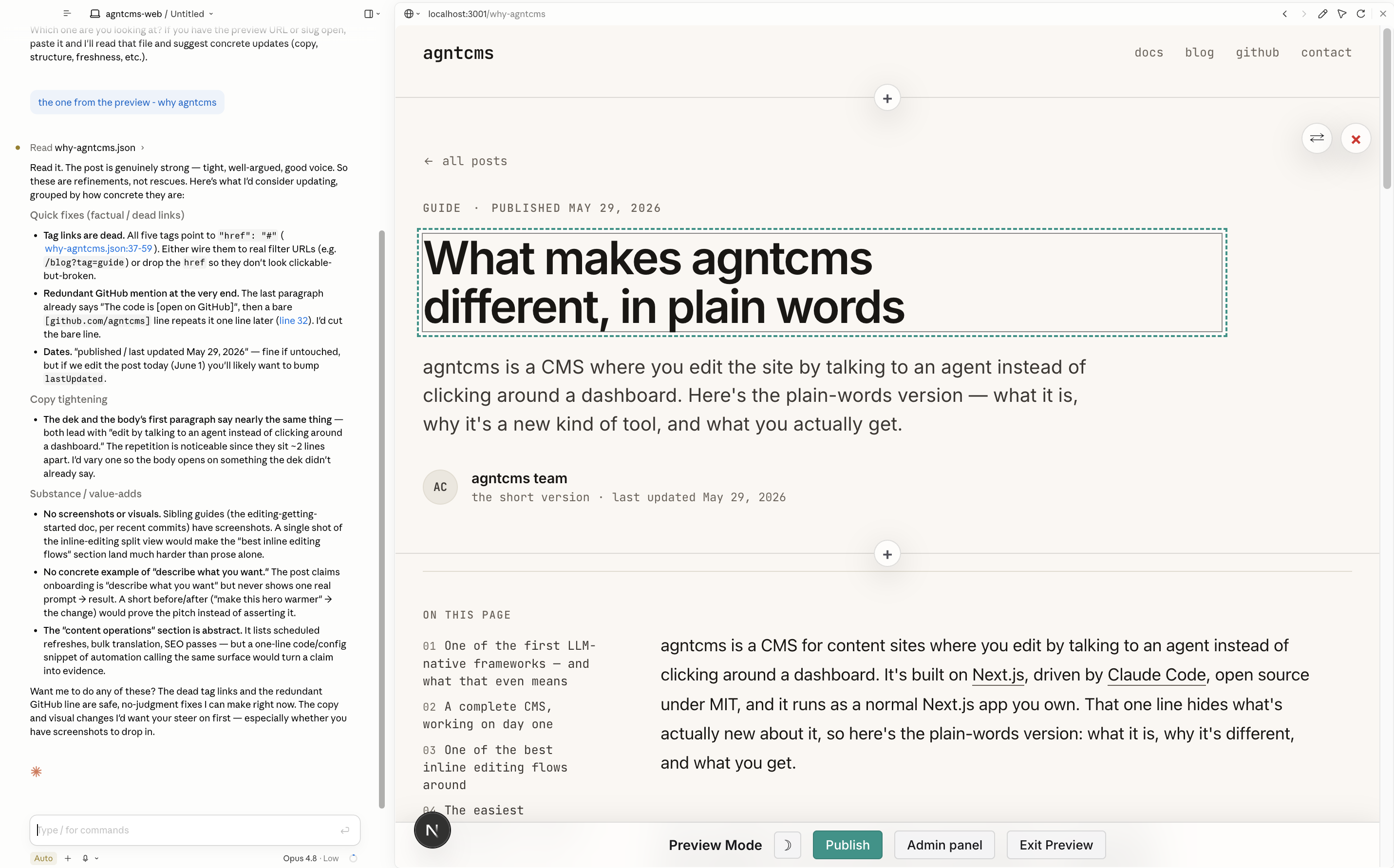
agntcms is a CMS for content sites where you edit by talking to an agent instead of clicking around a dashboard. It's built on Next.js, driven by Claude Code, open source under MIT, and it runs as a normal Next.js app you own. That one line hides what's actually new about it, so here's the plain-words version: what it is, why it's different, and what you get.
Nearly every CMS now advertises "AI." Look closely and it's almost always the same shape: the editor and its dashboard were built for a human, and an AI assistant was bolted on top as a guest, clicking the same buttons you would. Useful, but added on.
agntcms is built the other way round. The agent is the primary way you work with the site, and the CMS is arranged around it. You describe what you want in plain language, the agent does the work, and the page updates in front of you. That's what LLM-native means here — not a feature with an AI label, but the thing the whole framework is shaped around.
Very few tools are built this way today. That's the point: it's early, and being early is exactly what makes the clean version possible — there's no decade of dashboard habits to design around.
You don't assemble the basics. They're already there the moment you open the project:
The unglamorous-but-essential plumbing of a CMS is done. You start from a working content system, not an empty one.
For small changes you don't even need a conversation. Start the site, flip on preview mode, and every piece of editable text and every image lights up on hover. Click, and you edit it in place — markdown on one side, live preview on the other.
And because the editing surface is Claude Code Desktop, the chat and the live preview sit in one window. Point at a block — "make this hero warmer" — the agent edits it, the preview refreshes, you never leave the page. Two ways to work, talk for the big changes and click for the small ones, both on the same content underneath. See the editing flow.
This is the part that's hard to oversell. With a traditional headless CMS, a new editor needs days to learn the dashboard — where the fields live, what each toggle does, which order to touch things in.
Here, once a developer has set up the project and handed it over, onboarding is roughly: open the project and describe what you want. There's no dashboard to memorise. The know-how for adding a page, swapping a section, fixing a heading, or rolling back a change already lives inside the project, and the agent reaches for the right tool on its own. If you can say what you want, you can edit the site.
The same controls a person uses by talking are the ones your automation can call directly. Scheduled content refreshes, bulk translation into a new language, an SEO pass across every page, turning a brief into a draft — these run against the same surface, not a separate API stitched on through webhooks and a vendor SDK.
For a team that means your content-ops automation and your CMS are one system, not two that have to be kept in sync.
You're not locked into one vendor's AI or its meter. The controls your automation calls are plain building blocks — point them at whatever models and pipelines you already run. And because the framework is yours, no CMS vendor sits between you and your content charging per action to let an agent touch it.
agntcms is MIT-licensed, self-hosted, and free of per-seat pricing. No cap on content types, no paywall on a fourth language, no sales call to unlock a feature. It deploys as an ordinary Next.js app — headless-grade capability at the cost of the hosting you were already paying for. You can read every line, fork it, and run it for as long as you like.
A full CMS where you edit by talking. Editor onboarding that's "describe what you want." Automation that drives the same controls. Your own models, no vendor meter. Open source, running as a normal Next.js app you own.
For most content sites — marketing pages, landing pages, corporate sites, content portals — that's a better deal than the setup you're paying for now. That's the whole pitch, and every part of it is easy to check.
Start with the docs, or read the manifesto for the longer argument. The code is open on GitHub.
github.com/agntcms
One of the first LLM-native frameworks — and what that even means
Nearly every CMS now advertises "AI." Look closely and it's almost always the same shape: the editor and its dashboard were built for a human, and an AI assistant was bolted on top as a guest, clicking the same buttons you would. Useful, but added on.
agntcms is built the other way round. The agent is the primary way you work with the site, and the CMS is arranged around it. You describe what you want in plain language, the agent does the work, and the page updates in front of you. That's what LLM-native means here — not a feature with an AI label, but the thing the whole framework is shaped around.
Very few tools are built this way today. That's the point: it's early, and being early is exactly what makes the clean version possible — there's no decade of dashboard habits to design around.
A complete CMS, working on day one
You don't assemble the basics. They're already there the moment you open the project:
- Drafts and version history. Every edit is saved as a draft first. Publishing takes a dated snapshot, so nothing is ever overwritten and going back is one step. You can always return to last week's version.
- Asset management. Drop in images and files; duplicates are detected and caching is handled for you. No media-library busywork.
- Section swap. Don't like how a block is laid out? Replace it with a different one and the framework fills in sensible defaults, keeping the page valid the whole way through.
- A fast, frozen production site. None of the editing machinery ships to your visitors. What goes live is a plain, fast Next.js site with no AI running behind it — so the public site stays quick and simple.
The unglamorous-but-essential plumbing of a CMS is done. You start from a working content system, not an empty one.
One of the best inline editing flows around
For small changes you don't even need a conversation. Start the site, flip on preview mode, and every piece of editable text and every image lights up on hover. Click, and you edit it in place — markdown on one side, live preview on the other.
And because the editing surface is Claude Code Desktop, the chat and the live preview sit in one window. Point at a block — "make this hero warmer" — the agent edits it, the preview refreshes, you never leave the page. Two ways to work, talk for the big changes and click for the small ones, both on the same content underneath. See the editing flow.
The easiest onboarding for content editors you'll find
This is the part that's hard to oversell. With a traditional headless CMS, a new editor needs days to learn the dashboard — where the fields live, what each toggle does, which order to touch things in.
Here, once a developer has set up the project and handed it over, onboarding is roughly: open the project and describe what you want. There's no dashboard to memorise. The know-how for adding a page, swapping a section, fixing a heading, or rolling back a change already lives inside the project, and the agent reaches for the right tool on its own. If you can say what you want, you can edit the site.
Content operations that plug straight in
The same controls a person uses by talking are the ones your automation can call directly. Scheduled content refreshes, bulk translation into a new language, an SEO pass across every page, turning a brief into a draft — these run against the same surface, not a separate API stitched on through webhooks and a vendor SDK.
For a team that means your content-ops automation and your CMS are one system, not two that have to be kept in sync.
Bring your own models
You're not locked into one vendor's AI or its meter. The controls your automation calls are plain building blocks — point them at whatever models and pipelines you already run. And because the framework is yours, no CMS vendor sits between you and your content charging per action to let an agent touch it.
Open source, and genuinely yours
agntcms is MIT-licensed, self-hosted, and free of per-seat pricing. No cap on content types, no paywall on a fourth language, no sales call to unlock a feature. It deploys as an ordinary Next.js app — headless-grade capability at the cost of the hosting you were already paying for. You can read every line, fork it, and run it for as long as you like.
The short version
A full CMS where you edit by talking. Editor onboarding that's "describe what you want." Automation that drives the same controls. Your own models, no vendor meter. Open source, running as a normal Next.js app you own.
For most content sites — marketing pages, landing pages, corporate sites, content portals — that's a better deal than the setup you're paying for now. That's the whole pitch, and every part of it is easy to check.
Start with the docs, or read the manifesto for the longer argument. The code is open on GitHub.
github.com/agntcms